Porto, 14 October
Arrábida Room
Robots that fold, read intentions and know when to step in: TORNADO presents new results at ADRF26
At the AI, Data and Robotics Forum in Porto, researchers from IIT and UPC-IRI presented results on robots that handle deformable objects and interact safely with people, and Eurecat discussed what it takes to deploy them. Companies in the audience asked for access to the project’s foundation models and guarantees on data sovereignty.
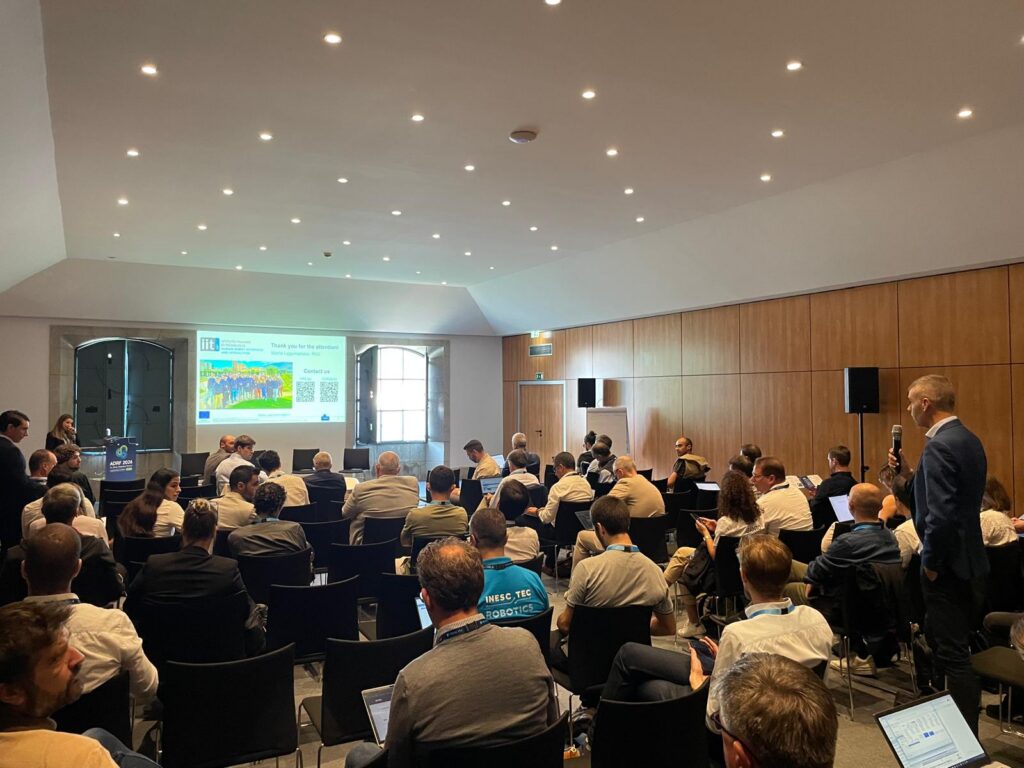
Mantua, 19 October 2026 – The Horizon Europe project TORNADO, coordinated by ITML, presented its latest research results at the AI, Data and Robotics Forum 2026 (ADRF26), organised by ADRA and INESC TEC in Porto. On 14 October, the project’s workshop “When Robots Learn to Interact: Foundation Models for Human-Robot Collaboration and Dexterous Manipulation in Healthcare and Industry” filled the Arrábida Room of the Alfândega do Porto Congress Centre.
Introduced by Simona Aceto of NSBproject, the session tackled one question: what it takes for robots built on foundation models to move from laboratory prototypes to reliable work in hospitals and factories.
Deformable objects: from one-off solutions to reusable skills
Marta Lagomarsino (IIT) presented results on materials that change shape as the robot handles them, such as fabric sheets, cables and small tubes:
- Folding sheets. Placement and folding of deformable sheets with a single camera, trained in simulation and transferred to real robots, with recovery from disturbances.
- Cables and tubes. Positioning of deformable linear objects by tracking a few keypoints instead of their complete geometry, with effective sim-to-real transfer.
- Learning from human videos. A library of motion strategies extracted from human demonstrations, from which a vision-language model retrieves and adapts the right one for the context.
- Common-sense reasoning. Large language models let non-expert users adapt the robot’s plan in natural language and help allocate roles between humans and robots.
“Imagine changing the material, the initial configuration or the instruction. How much of the solution can the robot reuse? This is where foundation models become relevant.“
Reading intentions and knowing when to step in
Valerio Bo (IRI, CSIC-UPC) started from a hospital scenario: a robot handling a delicate IV bag must decide whether to assist, yield or communicate when a doctor rushes towards the patient. His results cover three steps:
- Understanding intention. Algorithms that predict whether a person wants to interact with or avoid the robot. User studies show how fragile trust is: high latency breaks the fluency of interaction, wrong guesses break trust.
- Acting transparently. The Perception-Awareness-Decision (PAD) framework for socially aware navigation, with robots that show their intentions early, for example by shifting their gaze or path.
- Deciding when to intervene. Tests show that engagement and intrusiveness are deeply personal: there is no universal threshold, so the robot’s behaviour must be personalised.
“Physical dexterity is only half the battle. The other half is social interaction: the robot has to understand what we are doing, communicate what it plans to do, and know exactly when to step in.“
From demo to deployment
Néstor García Hidalgo (Eurecat) explained why robots that perform well in the lab still rarely do useful daily work in factories and hospitals. He identified four dimensions of the deployment gap – variation, failure and recovery, workflow integration, evidence and trust – and argued that benchmarks should measure end-to-end task success, recovery and impact. He also presented GRAIL, the Eurecat-coordinated initiative building a European general-purpose foundation model for robotics.
“A great demo is not a deployment. A one-off success proves feasibility, not operational readiness.“
Industry asks for access to the models
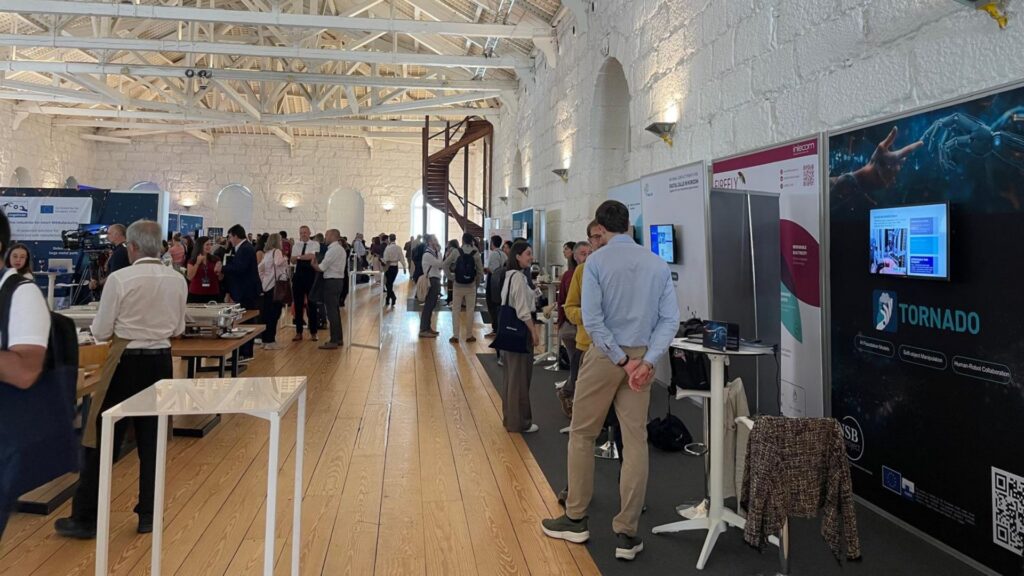
Questions from companies continued after the session and focused on two points: access to the foundation models developed in TORNADO, and guarantees on data sovereignty.
“Foundation models are a topic that interests everyone. Many companies asked about access to these models and about data sovereignty, which drew a lot of interest. The requests for access are telling: they show a real interest from industry in the artefacts and exploitable results the project is producing.” – Michele Ferramola, NSBproject
The three talks converged on one conclusion: dexterity, social judgment and continuous validation must advance together for adaptive robots to be trusted in real workplaces. These insights will inform TORNADO’s validation and exploitation activities. The full workshop report, with photos and the publications cited in the talks, is available on the project website.
About TORNADO
TORNADO (foundaTion mOdels for Robots that haNdle smAll, soft and Deformable Objects) is a Horizon Europe project running from January 2025 to June 2028. It is developing a cloud robotics platform that lets autonomous mobile robots navigate complex, human-populated indoor environments and handle small, soft and deformable objects. The robots interact naturally through voice and gestures, learn new skills from AR-based demonstrations, and adapt continuously through real-world feedback. Use cases are being validated in a gears factory, a hospital and a plant distribution centre. Project Coordinator: ITML
More at tornado-horizon.eu | https://www.linkedin.com/showcase/tornadohorizon
Media contact
Katerina Poriazi – ITML: k.poriazi@itml.gr
Lucia Barbiero and Simona Aceto – NSBproject: l.barbiero@nsbproject.com, s.aceto@nsbproject.com
TORNADO is funded by the European Union under Grant Agreement No. 101189557. Views and opinions expressed are however those of the author(s) only and do not necessarily reflect those of the European Union or the European Health and Digital Executive Agency (HaDEA). Neither the European Union nor the granting authority can be held responsible for them.